
Capstone Essay: "To Abolish War" |
|
Capstone Essay: "To Abolish War"
"Once social change begins, it cannot be reversed. You cannot uneducate the person who has learned to read. You cannot humiliate the person who feels pride. You cannot oppress the people who are not afraid anymore. We have seen the future, and the future is ours." - Cesar Chavez
Journal of Aggression, Conflict and Peace Research
Vol. 2 (4): 44-56 - 0ctober 2010
Judith L. Hand
Vol. 2 (4): 44-56 - 0ctober 2010
Judith L. Hand
[Keywords: war, peace, nomadic hunter-gatherers, origin of war, war system, war machine, Gandhi, nonviolence, civil disobedience, satyagraha, Agricultural Revolution, Egalitarian Revolution, female preference for social stability, " full world," dominator cultures, paradigm shift, Constructive Program (" good works" ), Obstructive Program, good works enable war machine, gender differences, rapid cultural change, revolution, Liberia, female+male peace movement, gender partnership, peace lever, peace fulcrums, landmines, cluster bombs, nuclear weapons, United Nations, necessary leadership]
To Abolish War
|
Summary: The thesis of this essay is that the institution of war could be abolished through a combination of Constructive Programs and Obstructive Programs. Good works alone won't end war. To transform dominator, warring cultures into egalitarian and nonwarring ones, Constructive Programs are needed to prepare the way, to establish the groundwork for a new lifestyle. But alone they will not result in a paradigm shift to a Gene Roddenberry-style Star Trek future on earth in which there is gender and racial equality, poverty has been eliminated, and conflicts are resolved by the rule of law instead of through military force. Paradoxically, Constructive Programs unless paired with the force of Obstructive Programs can enable dominator cultures to remain firmly in place. Moreover, to bring about a major social transformation we will need leaders to unite men and women as full partners in shaping a massive cultural shift to a more egalitarian, just, and nonwarring future.
|
Can the people of earth bring an end to the barbaric practice of war? Or is making war—assembling armed groups that go forth to indiscriminately kill members of other groups—something evolution built into our biology—an inescapable, inevitable curse that at best can only be managed and mitigated?
Background – Culture Fosters War
Although traits that make us vulnerable to building armies and making war are a part of our biology, war itself emerges as a consequence of culture (Hand 2003, Hand 2005, Hand 2006a). Factors responsible for the emergence of war are, to be sure, complex, but if we change our dominant cultures in appropriate ways, and we can eliminate war.
Originally the most critical of these war-fostering factors was probably the onset of settled living around rich, stable resources that could be hoarded, coveted, defended, stolen, or appropriated by force. The massive cultural shift we made away from the nomadic hunter- gatherer lifestyle that characterized our species for hundreds of thousands of years began in earnest with the Agricultural Revolution, roughly 10,000 years ago.
Anthropologist Douglas Fry (2006) points out some major cultural shifts that accompanied taking up a settled lifestyle. Among them were the development of hierarchical social structures, disempowerment of women that accompanied a loss of gender equality characteristic of nomadic forager societies, and the emergence of war.
The loss of status by women resulted increasingly over time in the removal of female input into decisions about how to resolve conflicts, especially inter-group conflicts. Consequently, in conflict situations for the past ten millennia or so, male biological priorities that favor obtaining high status and dominance using force if necessary went unchecked by female inclinations. Female inclinations at all levels of social interaction generally favor behavior that is known to foster social stability (Hand 2003). For example, women, in general, are more strongly inclined than are men to resolve conflicts, personal or inter-group, using nonviolent means such as negotiation and compromise (Fisher 1999). Women are not without competitive and aggressive tendencies. To establish their dominance hierarchies they may use not so "peaceful" means such as gossip, backbiting and innuendo. But women, much more than men, prefer to avoid physical aggression and killing that might endanger the women, their families, close associates, and especially their children (Campbell 1999). Remove that female preference for negotiation and compromise, and the result will be unchecked tendencies to respond aggressively that are part and parcel of male biology with an inevitable decline in social stability. In the public sphere, we now see around us the results of more than 10,000 years of predominantly male-shaped priorities, governing styles, and decision-making.
It's also clear that another consequence of adopting settled lifestyles was rapid growth of population size. The case has been made (e.g., Daly 2005) that we now live in a "full world." People without basic life resources (food, water, shelter) will go to war to get them, and to the extent that continuing explosion of a human population seeking basic and limited resources creates fundamental needs that go unmet, we are unlikely to abolish war (Hand 2005b, 2005c, 2006b,2006c). We must shift our economies from ones based on continual economic growth fueled by population growth to economies that focus on environmental sustainability. The result of this population growth while the world was still "empty" was the successive establishment of cultures that flourished, exhausted their environmental resources, and declined or disappeared altogether. This process is documented by many studies and nicely summarized by the scientist Jared Diamond (2004) in his book Collapse: How Societies Choose to Fail or Succeed.
Another consequence of this change in our lifestyle was emergence of a series of cultures and ways of governing that, at their core, are built on hierarchy (not equality) where status and control of the majority by an elite minority is maintained ultimately by the threat or use of force. Kingships, Tyrannies, Communism, Socialism, Capitalism: all share this same defining characteristic, the use of force by an elite to maintain power. The social historian Riane Eisler (2007) notes that acceptance and legitimization of the principle of domination by force begins in our homes, is then reflected in the life of the community composed of such homes, and ultimately infects relations between groups of people and nations. It is a "system" into which we are born and raised. In a series of books and articles, she called these ways of living "dominator cultures," an apt description. To live as peaceful people and still tolerate the practice of war, which is the ultimate expression of domination by force, is a contradiction. We will never end war unless we end acceptance of domination by force.
To emphasize a central point, if we change key aspects of our current "dominator cultures," eliminating conditions that foster war and establishing conditions that foster peace, egalitarianism, and justice, it follows that we can alter the course of history. We can not only end war, but we will put into place a cultural paradigm which is more egalitarian, just, nonviolent, and ecologically sustainable, characteristics most of us consider desirable. More peaceful homes and communities would result as a consequence of what might be called The Egalitarian Revolution.
In this essay:
Originally the most critical of these war-fostering factors was probably the onset of settled living around rich, stable resources that could be hoarded, coveted, defended, stolen, or appropriated by force. The massive cultural shift we made away from the nomadic hunter- gatherer lifestyle that characterized our species for hundreds of thousands of years began in earnest with the Agricultural Revolution, roughly 10,000 years ago.
Anthropologist Douglas Fry (2006) points out some major cultural shifts that accompanied taking up a settled lifestyle. Among them were the development of hierarchical social structures, disempowerment of women that accompanied a loss of gender equality characteristic of nomadic forager societies, and the emergence of war.
The loss of status by women resulted increasingly over time in the removal of female input into decisions about how to resolve conflicts, especially inter-group conflicts. Consequently, in conflict situations for the past ten millennia or so, male biological priorities that favor obtaining high status and dominance using force if necessary went unchecked by female inclinations. Female inclinations at all levels of social interaction generally favor behavior that is known to foster social stability (Hand 2003). For example, women, in general, are more strongly inclined than are men to resolve conflicts, personal or inter-group, using nonviolent means such as negotiation and compromise (Fisher 1999). Women are not without competitive and aggressive tendencies. To establish their dominance hierarchies they may use not so "peaceful" means such as gossip, backbiting and innuendo. But women, much more than men, prefer to avoid physical aggression and killing that might endanger the women, their families, close associates, and especially their children (Campbell 1999). Remove that female preference for negotiation and compromise, and the result will be unchecked tendencies to respond aggressively that are part and parcel of male biology with an inevitable decline in social stability. In the public sphere, we now see around us the results of more than 10,000 years of predominantly male-shaped priorities, governing styles, and decision-making.
It's also clear that another consequence of adopting settled lifestyles was rapid growth of population size. The case has been made (e.g., Daly 2005) that we now live in a "full world." People without basic life resources (food, water, shelter) will go to war to get them, and to the extent that continuing explosion of a human population seeking basic and limited resources creates fundamental needs that go unmet, we are unlikely to abolish war (Hand 2005b, 2005c, 2006b,2006c). We must shift our economies from ones based on continual economic growth fueled by population growth to economies that focus on environmental sustainability. The result of this population growth while the world was still "empty" was the successive establishment of cultures that flourished, exhausted their environmental resources, and declined or disappeared altogether. This process is documented by many studies and nicely summarized by the scientist Jared Diamond (2004) in his book Collapse: How Societies Choose to Fail or Succeed.
Another consequence of this change in our lifestyle was emergence of a series of cultures and ways of governing that, at their core, are built on hierarchy (not equality) where status and control of the majority by an elite minority is maintained ultimately by the threat or use of force. Kingships, Tyrannies, Communism, Socialism, Capitalism: all share this same defining characteristic, the use of force by an elite to maintain power. The social historian Riane Eisler (2007) notes that acceptance and legitimization of the principle of domination by force begins in our homes, is then reflected in the life of the community composed of such homes, and ultimately infects relations between groups of people and nations. It is a "system" into which we are born and raised. In a series of books and articles, she called these ways of living "dominator cultures," an apt description. To live as peaceful people and still tolerate the practice of war, which is the ultimate expression of domination by force, is a contradiction. We will never end war unless we end acceptance of domination by force.
To emphasize a central point, if we change key aspects of our current "dominator cultures," eliminating conditions that foster war and establishing conditions that foster peace, egalitarianism, and justice, it follows that we can alter the course of history. We can not only end war, but we will put into place a cultural paradigm which is more egalitarian, just, nonviolent, and ecologically sustainable, characteristics most of us consider desirable. More peaceful homes and communities would result as a consequence of what might be called The Egalitarian Revolution.
In this essay:
- We consider whether it is possible for humans to purposely change our cultures in ways that would shape the future so that it is more aligned with what we want, rather than simply being swept along by uncontrollable forces.
- We look at just how deeply embedded the practice of war has become in our dominant cultures—the attractive, even addictive, properties of war—and how working to end the practice is to participate in revolution (using nonviolent means).
- We evaluate two different kinds of efforts that would be involved in bringing about and maintaining such a massive paradigm shift, what has been called Constructive Program and Obstructive Program. We compare these different, but equally essential, efforts by focusing on examples from arguably the greatest practitioner of nonviolent social change, Mohandas Gandhi.
- We explore why "good works" alone (that is, Constructive Programs) are not sufficient to abolish war.
- Using the analogy of lever and fulcrum to illustrate a purposeful cultural shift, the essay considers the need for a campaign to abolish war to have leaders who keep participants (the lever) focused on the goal and who make strategic decisions about actions to be taken (the fulcrums).
- We consider briefly some critical gender differences when it comes to using physical aggression, the ultimate physical aggression being war, and conclude that partnership of men and women in decision-making and waging an ending-war campaign is essential, neither sex alone being able to accomplish this change.
- Some weak points in the war machine are suggested as suitable spots to place fulcrums and apply leverage for social change.
Shaping History
So how do we go about creating a future without war? What would it take to shape history in the direction we desire? Do we even have the capacity to shape history, or are we helpless victims of biology or other powers beyond our control? And if we can make change happen in ways we choose, how do we accomplish this?
There are any number of examples that remind us that not only do we have the power to shape our cultures, we have the power to do it remarkably quickly when we put our minds (and money) to it.
Changes can be achieved on a small scale. For example, in 1981 the Chatino Indians in southern Mexico decided to make changes (Greenberg 1981). They brought about land reforms and enacted new laws. And they also experienced a movement initiated by village women who were "sick of seeing their men killed in blood feuds." The majority of the village came to support passing and strict enforcement of laws banning alcohol consumption and unauthorized carrying of guns and knives. The high homicide rates dropped to very low ones in a short time span.
Changes can be achieved on a larger scale. In the mid- to late 1800s in the United States, people, mostly men, had the habit of chewing tobacco. Saloons, banks, railway cars, and other locations provided spittoons to receive the saliva generated by the habit. After the 1913 flu epidemic, health concerns brought the public use of spittoons into disfavor, and by the 1930's the use of public spittoons had died. Similarly, when it became very clear in the United States that second- hand tobacco smoke could give non-smokers cancer, laws were passed and public smoking was banned in less than a generation. This trend continues to spread.
In China for a millennium, the epitome of beauty in a woman was to have tiny feet, feet so small that a woman, for all practical purposes, could not walk. In 1911 the new Republic of China banned foot binding and, although it was practiced in secret for years, it is now defunct. A millennia-old practice ceased in less than a hundred years.
One of the most impressive cultural change projects, because of the massive shift in thinking that was involved, was the Christianization, by the Catholic Church and others, of most of Latin America, in many societies often in less than one generation. Although many elements of traditional beliefs have persisted in some places even to the present day, many long-practiced behaviors changed. Clothing might be used to cover more of the human body. Taking multiple wives was eliminated. Where it had been practiced before, head hunting ceased as the new value system spread.
The implication of these examples is that to argue that we cannot end war because we are the passive victims of culture, or that ending war is an impractical goal to embrace because doing so would take centuries are simply not legitimate arguments. We could end war in two generations or less if we apply our minds and resources to the challenge.
It is true, however, that war is a long-practiced, deeply embedded, and widely-spread bad habit. We celebrate and love our warriors as the Chinese loved those tiny feet. Our art, literature, and films often glorify war. War can have almost addictive properties, vividly explored in Chris Hedges' book War is a Force that Gives Us Meaning (2002). Ending war won't be easy. The level of difficulty of our challenge is perhaps like establishing a permanent base on Mars—very difficult, extremely difficult, but not impossible if we really, really want it and pursue it with unswerving vision and passion. It would not even take "centuries."
There are any number of examples that remind us that not only do we have the power to shape our cultures, we have the power to do it remarkably quickly when we put our minds (and money) to it.
Changes can be achieved on a small scale. For example, in 1981 the Chatino Indians in southern Mexico decided to make changes (Greenberg 1981). They brought about land reforms and enacted new laws. And they also experienced a movement initiated by village women who were "sick of seeing their men killed in blood feuds." The majority of the village came to support passing and strict enforcement of laws banning alcohol consumption and unauthorized carrying of guns and knives. The high homicide rates dropped to very low ones in a short time span.
Changes can be achieved on a larger scale. In the mid- to late 1800s in the United States, people, mostly men, had the habit of chewing tobacco. Saloons, banks, railway cars, and other locations provided spittoons to receive the saliva generated by the habit. After the 1913 flu epidemic, health concerns brought the public use of spittoons into disfavor, and by the 1930's the use of public spittoons had died. Similarly, when it became very clear in the United States that second- hand tobacco smoke could give non-smokers cancer, laws were passed and public smoking was banned in less than a generation. This trend continues to spread.
In China for a millennium, the epitome of beauty in a woman was to have tiny feet, feet so small that a woman, for all practical purposes, could not walk. In 1911 the new Republic of China banned foot binding and, although it was practiced in secret for years, it is now defunct. A millennia-old practice ceased in less than a hundred years.
One of the most impressive cultural change projects, because of the massive shift in thinking that was involved, was the Christianization, by the Catholic Church and others, of most of Latin America, in many societies often in less than one generation. Although many elements of traditional beliefs have persisted in some places even to the present day, many long-practiced behaviors changed. Clothing might be used to cover more of the human body. Taking multiple wives was eliminated. Where it had been practiced before, head hunting ceased as the new value system spread.
The implication of these examples is that to argue that we cannot end war because we are the passive victims of culture, or that ending war is an impractical goal to embrace because doing so would take centuries are simply not legitimate arguments. We could end war in two generations or less if we apply our minds and resources to the challenge.
It is true, however, that war is a long-practiced, deeply embedded, and widely-spread bad habit. We celebrate and love our warriors as the Chinese loved those tiny feet. Our art, literature, and films often glorify war. War can have almost addictive properties, vividly explored in Chris Hedges' book War is a Force that Gives Us Meaning (2002). Ending war won't be easy. The level of difficulty of our challenge is perhaps like establishing a permanent base on Mars—very difficult, extremely difficult, but not impossible if we really, really want it and pursue it with unswerving vision and passion. It would not even take "centuries."
Ending War is Revolution, and we are Historically Positioned to Succeed
A series of short videos (Hand 2010) in a DVD entitled "Ending War is Achievable, Five Reasons Why" explore whether it's reasonable to believe we could create a future with the type of peace on earth envisioned by Gene Roddenberry's original Star Trek as an alternative to either endless wars or some murderous totalitarian peace a la Joseph Stalin. In that Roddenberry Star Trek future there were wars off in space with aliens—a device for dramatic purposes to reflect our current reality—but on Gene Roddenberry's earth, people finally lived in peace in a sexually and racially egalitarian society where conflicts were resolved by the rule of law. In that Star Trek future we'd be spending our talents on, for example, invention, art, self-development, exploration. Instead, much of the world's economy and our emotional energies now depend upon, or are obsessed with, wars: planning them; waging them; the designing, buying, and selling of weapons for them; cleaning up the damage after them; even working in hopes of preventing them.
Ending war involves shaping, fostering, and pushing a major paradigm shift perhaps as substantial as the Agricultural Revolution itself. Moreover, ending war and doing the many things required in our homes, communities, and institutions to make that happen is, in fact, a highly subversive proposition. It won't be welcomed by all. War makes some people rich. Those enriched by war also typically belong to the elite governing class, in whatever form of government is involved—people who control the media and the engines of commerce. The tiny minority of men, hyper-alpha males, who are the generators of wars, also thereby accrue power and status (Hand 2005d, 2006d, 2010). And a great many ordinary folks make their livings in some aspect, directly or indirectly, from the war industry.
The idea that we can actually terminate war and everything involved in it, if taken seriously, is going to make many powers-that-be extremely uncomfortable. A compelling case can be made, however, that we need to make them uncomfortable, very uncomfortable, before, for whatever reason, we run out of time and our window of opportunity to use nonviolence to shape this positive change closes (Hand 2005e). An essay entitled "How Far We Have Already Come" describes how six major historical events going back roughly 700 years make our moment in history uniquely poised to bring off a campaign to abolish war (Hand 2005f, Hand 2006a). These critical events are the Renaissance and Reformation; the advent of the modern scientific method; the British, French, and American Revolutions; the enfranchisement of women; the development of reliable means of family planning; and the invention of the Internet. History has not stopped, nor has change, and not all changes that are occurring are positive. Our window of opportunity will not remain open forever. We urgently need to focus, put together a campaign, grasp this opportunity, and get moving.
Mohandas Gandhi, arguably the foremost master of social transformation by nonviolent means, engaged in what he called "Constructive Program," and also what others have called by way of parallel construction, "Obstructive Program" (Nagler, undated). Obstructive Program comprises nonviolent actions of civil disobedience, something we'll return to after considering Constuctive Programs.
Ending war involves shaping, fostering, and pushing a major paradigm shift perhaps as substantial as the Agricultural Revolution itself. Moreover, ending war and doing the many things required in our homes, communities, and institutions to make that happen is, in fact, a highly subversive proposition. It won't be welcomed by all. War makes some people rich. Those enriched by war also typically belong to the elite governing class, in whatever form of government is involved—people who control the media and the engines of commerce. The tiny minority of men, hyper-alpha males, who are the generators of wars, also thereby accrue power and status (Hand 2005d, 2006d, 2010). And a great many ordinary folks make their livings in some aspect, directly or indirectly, from the war industry.
The idea that we can actually terminate war and everything involved in it, if taken seriously, is going to make many powers-that-be extremely uncomfortable. A compelling case can be made, however, that we need to make them uncomfortable, very uncomfortable, before, for whatever reason, we run out of time and our window of opportunity to use nonviolence to shape this positive change closes (Hand 2005e). An essay entitled "How Far We Have Already Come" describes how six major historical events going back roughly 700 years make our moment in history uniquely poised to bring off a campaign to abolish war (Hand 2005f, Hand 2006a). These critical events are the Renaissance and Reformation; the advent of the modern scientific method; the British, French, and American Revolutions; the enfranchisement of women; the development of reliable means of family planning; and the invention of the Internet. History has not stopped, nor has change, and not all changes that are occurring are positive. Our window of opportunity will not remain open forever. We urgently need to focus, put together a campaign, grasp this opportunity, and get moving.
Mohandas Gandhi, arguably the foremost master of social transformation by nonviolent means, engaged in what he called "Constructive Program," and also what others have called by way of parallel construction, "Obstructive Program" (Nagler, undated). Obstructive Program comprises nonviolent actions of civil disobedience, something we'll return to after considering Constuctive Programs.
Constructive Programs – Why they are Essential
Constructive Programs are essentially good works. Examples of Gandhi's Constructive Programs were his efforts to teach Indian villagers how to be self-reliant (a man who depends on others for his life essentials is not an entirely free man), and his work to end the evils of the "untouchable" class system.
Gandhi listed four stages of public response to any action that purports to instigate great social change:
first they ignore you,
then they laugh at you,
then they fight you,
then you win.
When it comes to abolishing war, we appear to be in phase one.
The good news is that legions of organizations and individuals are hard at work on some problems associated with wars. I've grouped these efforts into nine very broad categories (2005a; Hand 2006a), and almost all the activities can be considered good works, parts of "Constructive Program." They are efforts undertaken at the level of homes and communities as well as globally. They also form the backbone strategy of an ending-war plan of action (Hand 2005a; Hand 2006a).
The following names are used for these broad categories:
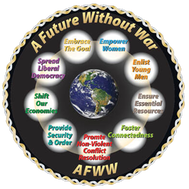
Embrace the Goal
Empower Women
Enlist Young Men
Foster Connectedness
Insure Essential Resources
Promote Nonviolent Conflict Resolution
Provide Security and Order
Shift our Economies
Spread Liberal Democracy
If you're an activist for humanitarian, environmental or peace causes, it's quite possible that you or your organization fit into one or more of these categories. In the AFutureWithoutWar.org project logo they are arranged in a circle, not a list, as a way to indicate that almost all are equally essential. Some require more attention than others in certain situations or countries at different times, but success in a campaign to end war would come more quickly and be more likely when all activities are simultaneously part of a coordinated effort (Hand 2005a, Hand 2006a, 2010).
These programs prepare the ground for living in that future we intend to create. They are the "good works" upon which we build. They are essential because unless we attend to them, shape them in necessary directions, each could pose an insurmountable barrier to a positive paradigm shift and could also result in backsliding from any progress.
Gandhi listed four stages of public response to any action that purports to instigate great social change:
first they ignore you,
then they laugh at you,
then they fight you,
then you win.
When it comes to abolishing war, we appear to be in phase one.
The good news is that legions of organizations and individuals are hard at work on some problems associated with wars. I've grouped these efforts into nine very broad categories (2005a; Hand 2006a), and almost all the activities can be considered good works, parts of "Constructive Program." They are efforts undertaken at the level of homes and communities as well as globally. They also form the backbone strategy of an ending-war plan of action (Hand 2005a; Hand 2006a).
The following names are used for these broad categories:
Embrace the Goal
Empower Women
Enlist Young Men
Foster Connectedness
Insure Essential Resources
Promote Nonviolent Conflict Resolution
Provide Security and Order
Shift our Economies
Spread Liberal Democracy
If you're an activist for humanitarian, environmental or peace causes, it's quite possible that you or your organization fit into one or more of these categories. In the AFutureWithoutWar.org project logo they are arranged in a circle, not a list, as a way to indicate that almost all are equally essential. Some require more attention than others in certain situations or countries at different times, but success in a campaign to end war would come more quickly and be more likely when all activities are simultaneously part of a coordinated effort (Hand 2005a, Hand 2006a, 2010).
These programs prepare the ground for living in that future we intend to create. They are the "good works" upon which we build. They are essential because unless we attend to them, shape them in necessary directions, each could pose an insurmountable barrier to a positive paradigm shift and could also result in backsliding from any progress.
Why Constructive Programs Alone Are Insufficient to Effect the End of War
It is now necessary to explore the somewhat painful truth that as wonderful as such good works are, they alone are not culturally transformative. They can transform individuals, change communities, and shape history in powerful ways. Such movements gave us democracy, nurses, hospice care, food relief, health care, education, and promote human rights. But alone, good works will not apply sufficient force to transform warrior cultures into nonwarring cultures. And what's worse, the painful part, is that they can actually enable violent, dominator war cultures to persist. Constructive Programs alone do not dismantle the war system.
An enabler is someone who helps another to persist in self-destructive behavior by helping that individual to avoid the consequences of his or her behavior. When we bring education, economic progress, better health care, and even democracy to those in need, we give them hope...hope for a better life...sometime. We do not, however, necessarily transform the war system.
Failure to understand this principle is why, with all the time and money and resources poured into aid, our dominator cultures, whether communist, socialist, or capitalist, or run by petty dictators, have not fundamentally changed. With rare exceptions—for example, increasingly the case in some of the Nordic countries—the elite at the top continue to live extravagantly well, the few in the middle class, where there is a middle class, are satisfied and pacified, the masses at the bottom suffer horribly, and we continue to make war.
And without pressure, our dominator cultures will not necessarily transform into egalitarian, nonwarring ones, no matter how many educated, healthy, and democratic countries we create. The old paradigm will persist with its control from the top down by deception, by "bread and circuses," where that works (as it often does), and by force if necessary. People will live much better in many ways. Consider, for example, what has evolved in the United States. Historically, it's the good life. But significant inequality and environmental havoc persist. So does violence in homes and communities. So does participation in war. All persist in spite of democracy, education, a relatively affluent lifestyle by historical standards, and remarkable, although not equally available, health care.
When viewed on a broader historical scale, Constructive Programs prevent the beneficiaries of aid from becoming so angry and desperate that they riot and pull down the elite and demand that not a penny, farthing, centime, or dinar be spent on war. Despite abundant good intentions, Constructive Programs can inadvertently allow the war system to escape the consequences of its bad behavior, at least for a time. The people remain sufficiently pacified so they are not a threat to the establishment. And when change comes, as it inevitably does, it's unlikely to move in a Star Trek direction. If by luck or visionary leadership it does, the desired shift won't persist and flower, because the necessary cultural factors favoring it aren't in place.
If we continue to think of violence and war as deplorable but still legitimate options, over time any progress toward democracy and peace slips and slides down slope into the old habitual dominator behavior. Arguably, the most impressive effort made to date at achieving a just society, a republic composed of equals, at peace, where conflict resolution was based on the rule of law rather than violence or force, was ancient Rome. We know how that turned out. It is important to note that Roman women were not allowed to share in making governing decisions, and nor were slaves. The system was rigged to fail from the beginning.
Typically, when the common folk get restive, or show signs of doing so, the war culture, through its witting and unwitting agents, simply stirs up a conflict elsewhere, another need to make war. The U.S. General Douglas McArthur expressed his perception of this phenomenon:
An enabler is someone who helps another to persist in self-destructive behavior by helping that individual to avoid the consequences of his or her behavior. When we bring education, economic progress, better health care, and even democracy to those in need, we give them hope...hope for a better life...sometime. We do not, however, necessarily transform the war system.
Failure to understand this principle is why, with all the time and money and resources poured into aid, our dominator cultures, whether communist, socialist, or capitalist, or run by petty dictators, have not fundamentally changed. With rare exceptions—for example, increasingly the case in some of the Nordic countries—the elite at the top continue to live extravagantly well, the few in the middle class, where there is a middle class, are satisfied and pacified, the masses at the bottom suffer horribly, and we continue to make war.
And without pressure, our dominator cultures will not necessarily transform into egalitarian, nonwarring ones, no matter how many educated, healthy, and democratic countries we create. The old paradigm will persist with its control from the top down by deception, by "bread and circuses," where that works (as it often does), and by force if necessary. People will live much better in many ways. Consider, for example, what has evolved in the United States. Historically, it's the good life. But significant inequality and environmental havoc persist. So does violence in homes and communities. So does participation in war. All persist in spite of democracy, education, a relatively affluent lifestyle by historical standards, and remarkable, although not equally available, health care.
When viewed on a broader historical scale, Constructive Programs prevent the beneficiaries of aid from becoming so angry and desperate that they riot and pull down the elite and demand that not a penny, farthing, centime, or dinar be spent on war. Despite abundant good intentions, Constructive Programs can inadvertently allow the war system to escape the consequences of its bad behavior, at least for a time. The people remain sufficiently pacified so they are not a threat to the establishment. And when change comes, as it inevitably does, it's unlikely to move in a Star Trek direction. If by luck or visionary leadership it does, the desired shift won't persist and flower, because the necessary cultural factors favoring it aren't in place.
If we continue to think of violence and war as deplorable but still legitimate options, over time any progress toward democracy and peace slips and slides down slope into the old habitual dominator behavior. Arguably, the most impressive effort made to date at achieving a just society, a republic composed of equals, at peace, where conflict resolution was based on the rule of law rather than violence or force, was ancient Rome. We know how that turned out. It is important to note that Roman women were not allowed to share in making governing decisions, and nor were slaves. The system was rigged to fail from the beginning.
Typically, when the common folk get restive, or show signs of doing so, the war culture, through its witting and unwitting agents, simply stirs up a conflict elsewhere, another need to make war. The U.S. General Douglas McArthur expressed his perception of this phenomenon:
|
Our government has kept us in a perpetual state of fear—kept us in a continuous stampede of patriotic fervor—with the cry of grave national emergency. Always there has been some terrible evil at home or some monstrous foreign power that was going to gobble us up if we did not blindly rally behind it. (MacArthur 1965).
|
D'Anievi (2010) describes how autocratic regimes (but usually not democracies) may go to war to use a successful military campaign to garner support from the public and to raise the popularity of the leaders through this "rally ‘round the flag" approach. He cites as an example that, in 1914, European powers such as England and Germany were eager to have a war to overshadow or delay calls within their countries for political reform. Although D'Anievi seems to generally dismiss this as a motivation for launching wars in democracies, observers have claimed, for example, that the Falklands war boosted the popularity of the British administration in power at that time, thus serving this very purpose (Crewe, 1988). The classic fictional portrayal of this phenomenon takes place in George Orwell's 1984 (Orwell, 1949). When their country is at war, folks are less likely to pursue internal revolution.
The dominator "system" perpetuates itself by means of customs and cultural expectations. Individuals, all of us, born into dominator systems are typically just swept along. Masses of good people get caught up in acceptance and support of war. People sometimes even help to generate a war. The dominator "system" sets us all up.
Note also that moving to end war does not translate into disarmament. Because of our biology, because of proclivities that are in our bones and being—male urges to rise in dominance and female urges to avoid conflicts that might lead to physical aggression, even when it might be in their best interests to stage a revolution—eternal vigilance will likely be required to create and maintain a future without war. It's possible that we may always need peacekeeping forces to immediately counter the next dominator who appears on the stage and is eager to raise an army to kill other humans standing in the way. We can hope that over time the size of such forces will diminish, their task becoming one primarily of policing our world community as Constructive Programs change the paradigm that governs our lives to one that is more egalitarian and adept at the skills of living in peace.
The dominator "system" perpetuates itself by means of customs and cultural expectations. Individuals, all of us, born into dominator systems are typically just swept along. Masses of good people get caught up in acceptance and support of war. People sometimes even help to generate a war. The dominator "system" sets us all up.
Note also that moving to end war does not translate into disarmament. Because of our biology, because of proclivities that are in our bones and being—male urges to rise in dominance and female urges to avoid conflicts that might lead to physical aggression, even when it might be in their best interests to stage a revolution—eternal vigilance will likely be required to create and maintain a future without war. It's possible that we may always need peacekeeping forces to immediately counter the next dominator who appears on the stage and is eager to raise an army to kill other humans standing in the way. We can hope that over time the size of such forces will diminish, their task becoming one primarily of policing our world community as Constructive Programs change the paradigm that governs our lives to one that is more egalitarian and adept at the skills of living in peace.
The Power of Obstructive Programs
The weight of history hangs heavy with many shifts in dominator power structures to other structures that, at their core, are essentially the same, so it's not only easy to be pessimistic about the possibility of ending war, it is also exactly why many people are skeptical that ending war is possible. But let us assume, now, that we continue to work on our nine cornerstones, the bases upon which we're constructing a Star Trekfuture on earth. If these alone can't produce the huge positive shift we're envisioning, what can? Here's where Obstructive Program comes in.
We turn to case studies and teachings of successful social transformers for insight into what produces success. We can examine movements of, for example, American suffragists like Alice Paul, Martin Luther King, Jr. and especially Mohandas Gandhi, a master planner and strategist of nonviolent social transformation.
Gandhi began his life's work in South Africa, but his greatest effort was to put sufficient pressure on the British that they would grant India, his homeland, its independence. Through years of struggle he learned how to nonviolently pursue social change. Note that Gandhi isn't famous for his efforts at Constructive Programs, things like teaching villagers to be self-reliant or ending the worst excesses of the "untouchable" class system. He is famous for his brilliant use of civil disobedience as part of a well-planned Obstructive Program that he used to confront the occupiers. Examples are the famous salt march (see below); the boycott against imported British products such as linens; and inviting his own arrest for organizing these protests, resulting in long years spent in prison. The reason we know him for these things is because this nonviolent confrontation was the force he applied to get the system to change—in this case, to convince the British they might as well leave India.
It is essential to a successful campaign that we fully grasp the important lesson that Gandhi's Constructive Programs alone would not have delivered victory. The power to effect profound, transformative change comes from confronting the evil that needs to be vanquished. It comes from Obstructive Programs. And what was true about Gandhi's struggle in India is also true for the challenge of ending war. World governing systems deeply entrenched in a war culture will let "do-gooders" do good until hell freezes over, while the fundamental war culture remains unaltered and those at the top who embrace that world view remain fully in control.
This is why devoting efforts to good works, while necessary, won't be sufficient to effect the massive paradigm shift away from war. The American suffragists and Martin Luther King, Jr. also used Obstructive Program (confronting the "system" using nonviolent civil disobedience), as have virtually all of the numerous successful 20th century nonviolent (velvet) revolutions (Sharp 2005, Stephan& Chenoweth 2008).
We turn to case studies and teachings of successful social transformers for insight into what produces success. We can examine movements of, for example, American suffragists like Alice Paul, Martin Luther King, Jr. and especially Mohandas Gandhi, a master planner and strategist of nonviolent social transformation.
Gandhi began his life's work in South Africa, but his greatest effort was to put sufficient pressure on the British that they would grant India, his homeland, its independence. Through years of struggle he learned how to nonviolently pursue social change. Note that Gandhi isn't famous for his efforts at Constructive Programs, things like teaching villagers to be self-reliant or ending the worst excesses of the "untouchable" class system. He is famous for his brilliant use of civil disobedience as part of a well-planned Obstructive Program that he used to confront the occupiers. Examples are the famous salt march (see below); the boycott against imported British products such as linens; and inviting his own arrest for organizing these protests, resulting in long years spent in prison. The reason we know him for these things is because this nonviolent confrontation was the force he applied to get the system to change—in this case, to convince the British they might as well leave India.
It is essential to a successful campaign that we fully grasp the important lesson that Gandhi's Constructive Programs alone would not have delivered victory. The power to effect profound, transformative change comes from confronting the evil that needs to be vanquished. It comes from Obstructive Programs. And what was true about Gandhi's struggle in India is also true for the challenge of ending war. World governing systems deeply entrenched in a war culture will let "do-gooders" do good until hell freezes over, while the fundamental war culture remains unaltered and those at the top who embrace that world view remain fully in control.
This is why devoting efforts to good works, while necessary, won't be sufficient to effect the massive paradigm shift away from war. The American suffragists and Martin Luther King, Jr. also used Obstructive Program (confronting the "system" using nonviolent civil disobedience), as have virtually all of the numerous successful 20th century nonviolent (velvet) revolutions (Sharp 2005, Stephan& Chenoweth 2008).
Lever and Fulcrums to Effect Change
Obstructive Programs work by applying pressure at vital points. The metaphor of the lever and fulcrum helps visualize this. The most popular variant of a quote by the Greek mathematician, scientist, and inventor Archimedes when he was demonstrating the principal of the lever is, "Give me a lever long enough and a fulcrum on which to place it, and I shall move the world". The massive world we intend to move, if you will, is the world view that accepts the culture of war.
So what about lever and fulcrum? We have little hard data to consider and only a few suggestive examples. One instructive example is the peace achieved in Liberia, in part by the united and unswerving nonviolent confrontation of their dictator, Charles Taylor, by Christian and Muslim women, documented in the film "Pray the Devil Back to Hell" (Disney & Reticker 2008).
The west-African country of Liberia was formed in 1847 by African Americans freed by the American civil war who had been repatriated to Africa. Through the years Liberia remained a republic, until a military coup in 1980. By 1985 Liberia again became a republic, but in 1989 Charles Taylor, an Americo-Liberian, overturned the elected government. This threw the country into civil war. By 2001, the brutality inflicted by the various military forces included rape, murder, and the taking of children as soldiers.
The documentary film chronicles the actions of Liberian women who reached what they considered to be the end of tolerance for the brutality (Disney & Reticker 2008). What began as a Christian prayer meeting asking for divine help ended up uniting women of the two faiths in a joint effort to use sit-downs at the local market and along the road where Taylor's caravan passed each day to insist that Taylor grant them a hearing. Eventually, unable to avoid the women any longer, Taylor, who was being accused of war crimes by the international community, granted them their request. In a dramatic confrontation, several hundred women came to support their representative as she respectfully asked Taylor to attend ceasefire talks in Ghana, and to make peace at those talks. Under pressure from many sides, Taylor agreed. Later, when the men at the talks appeared to be more interested in talking while agreeing to nothing, the women who had come to observe organized a sit-in at the meeting site, refusing to leave until a peace agreement was signed. As described by the film's promotional material, "The women held the men hostage until there was a signed peace treaty." Upon their return to Liberia, the women maintained their cohesion, with the result that Ellen Johnson Sirleaf was elected President in 2005, the first female elected head of state on the African continent.
So at what points do we choose to confront the war machine head on? I can suggest some possibilities, but only time can reveal how my suggestions, or any other actions and efforts, might actually play out.
So what about lever and fulcrum? We have little hard data to consider and only a few suggestive examples. One instructive example is the peace achieved in Liberia, in part by the united and unswerving nonviolent confrontation of their dictator, Charles Taylor, by Christian and Muslim women, documented in the film "Pray the Devil Back to Hell" (Disney & Reticker 2008).
The west-African country of Liberia was formed in 1847 by African Americans freed by the American civil war who had been repatriated to Africa. Through the years Liberia remained a republic, until a military coup in 1980. By 1985 Liberia again became a republic, but in 1989 Charles Taylor, an Americo-Liberian, overturned the elected government. This threw the country into civil war. By 2001, the brutality inflicted by the various military forces included rape, murder, and the taking of children as soldiers.
The documentary film chronicles the actions of Liberian women who reached what they considered to be the end of tolerance for the brutality (Disney & Reticker 2008). What began as a Christian prayer meeting asking for divine help ended up uniting women of the two faiths in a joint effort to use sit-downs at the local market and along the road where Taylor's caravan passed each day to insist that Taylor grant them a hearing. Eventually, unable to avoid the women any longer, Taylor, who was being accused of war crimes by the international community, granted them their request. In a dramatic confrontation, several hundred women came to support their representative as she respectfully asked Taylor to attend ceasefire talks in Ghana, and to make peace at those talks. Under pressure from many sides, Taylor agreed. Later, when the men at the talks appeared to be more interested in talking while agreeing to nothing, the women who had come to observe organized a sit-in at the meeting site, refusing to leave until a peace agreement was signed. As described by the film's promotional material, "The women held the men hostage until there was a signed peace treaty." Upon their return to Liberia, the women maintained their cohesion, with the result that Ellen Johnson Sirleaf was elected President in 2005, the first female elected head of state on the African continent.
So at what points do we choose to confront the war machine head on? I can suggest some possibilities, but only time can reveal how my suggestions, or any other actions and efforts, might actually play out.
The Most Likely Lever: A Global Female+Male Peace Movement
Millions of men and women must be engaged in cultivating this change to reach so-called "critical mass." The lever will most likely be a major women's peace movement, partnered with and supported by like-minded men. Why a women's movement? There are at least five reasons:
- Creating social stability (which is the direct opposite of war) is a built-in female passion; women are the NATURAL ALLIES of nonviolent conflict resolution, by which I mean tactics that do not involve killing, e.g., negotiation and compromise. The tactics we use in a campaign to abolish war must be nonviolent ones, and we do not need to teach women to prefer nonviolent means of conflict resolution over physical fighting (Hand 2003),
- Women and their children are frequent victims of wars, so women are well motivated to be attracted to the idea of ending the practice,
- Women are fabulous natural-born networkers,
- There are increasing numbers of women around the globe with education, financial resources, and status that can enable them as decision-makers.
- More and more men, including men with power, realize that the key to deep social change in less violent and less aggressive directions will require the participation of women.
Why a Campaign to Abolish War Requires Full Partnership of Women with Men
Women and their children suffer horribly from wars. Women and their young children are killed, they are raped, and their sons and husbands are taken away, often to die. Since they are commonly the victims of war, it seems reasonable to assume that if women alone could end war, they already would have done so.
Clearly, men have been unable to end war.
To understand why a male/female partnership is needed, it's necessary to understand how civil disobedience works. Gandhi developed a strategy of nonviolent civil disobedience similar to that used by the American suffragists, described around that same time in an essay by Henry David Thoreau (1849), and used successfully multiple times during the 20th century (Sharp, 2005; Stephan& Chenoweth 2008). Gandhi adopted this approach for a number of reasons, the most fundamental of which was his conviction that individuals must practice what they want to achieve. "Be the change you want to see," is a Gandhism often quoted. This means that to abolish the violence of war, we can't use violent means.
Gandhi called his strategy satyagraha. It is sometimes called "soul force," and was called by another great practitioner, Martin Luther King Jr., "Love in action." A pamphlet by Professor Michael Nagler describes Gandhi's work, the several definitions of satyagraha, the characteristics of satyagraha, and when and how to use it (Nagler undated).
Nonviolent civil disobedience requires both discipline and courage. Courage is necessary because not all confrontations will lack violence. The practitioner of satyagraha must be trained to remain nonviolent in the face of violent push back. They must be willing to risk physical injury, or worse. Judging by historical examples, those who propose to take on the war machine will likely find that when the system begins to fight the change, revolutionaries will face not only beatings and imprisonment: deaths will occur. When it comes to the end game, this radical change will come hard, not easy. To expect otherwise is to be unrealistic.
As argued elsewhere (Hand 2003), the need to avoid war, or more broadly, to maintain social stability, is the evolutionary selection pressure that has inclined women toward peaceful settlements and negotiation instead of leaping into battle. Because of women's greater investment in time, energy, and risk in their offspring, social turmoil that might lead to the death of offspring or their primary care giver is hugely counterproductive for women. It's much less counterproductive for men who are inclined to overturn the social order if by doing so they can acquire higher status. In studies done in Western cultures, traits such as seeking compromises rather than winner take all during negotiations are one of a number of traits that are more characteristic of women, in general, than men (Fisher 1999). Fisher describes others as well, such as "web-thinking" and foresight (Fisher 2005). Willingness to compromise serves women's evolved preference for maintaining a socially stable environment, since agreements reached by compromises and strictly enforced are more likely to lead to long- term stability between the parties (Ury 2000).
Investigations reviewed by Anne Campbell (1999) indicate that women, in general, prefer to avoid physical fighting, physical aggression, and violence. Campbell points out that, evolutionarily, this also serves to protect the women and their offspring from physical harm. In studies, mostly done in Western/patriarchal cultures, women are less inclined than are men to engage in competition and more averse to risk-taking in general.
These traits are not only women's strength, enabling them to protect themselves and their young, and to facilitate a more stable community in which to raise those young, they are a weakness. A preference for compromise rather than fighting and a preference for avoiding physical aggression prevent women from rising up to overturn the social order by armed revolution, even when it would be to their benefit to do so.
Because ending war will require overturning the established social acceptance of war and the war machine itself, it will create a great deal of social conflict for a time. Women, in general, will find that state extremely uncomfortable. When the war system fights back, ending war will require risk taking and persistence in the face of physically violent opposition. It is among men, in general, where you will be more likely to find a greater percentage of individuals of a temperament to persist, even at the risk of creating social disorder and even at great risk to life, to win this struggle. Men of that uncompromising and risk-taking temperament who take on this cause bring that strength to it. Men of that nature who participate in an ending-war campaign would be uncompromising in their efforts to settle for nothing less.
It's for these reasons that to achieve success using a nonviolent revolution, a global peace movement catalyzed by women with men as partners is the likely lever. Male risk taking and willingness to overturn the social order will be a driving force, and it will be tempered by female preference for nonviolence and compromise. We need to consciously apply the best (most appropriate) inclinations of both sexes to achieve the goal. Working in gender partnership, mobilizing women and men as both leaders and followers, will be the balancing key to a successful end to war and maintenance of that state once achieved. Past nonviolent victories like those of the American suffragists who sought the vote and the Liberian women who sought peace show the way.
Clearly, men have been unable to end war.
To understand why a male/female partnership is needed, it's necessary to understand how civil disobedience works. Gandhi developed a strategy of nonviolent civil disobedience similar to that used by the American suffragists, described around that same time in an essay by Henry David Thoreau (1849), and used successfully multiple times during the 20th century (Sharp, 2005; Stephan& Chenoweth 2008). Gandhi adopted this approach for a number of reasons, the most fundamental of which was his conviction that individuals must practice what they want to achieve. "Be the change you want to see," is a Gandhism often quoted. This means that to abolish the violence of war, we can't use violent means.
Gandhi called his strategy satyagraha. It is sometimes called "soul force," and was called by another great practitioner, Martin Luther King Jr., "Love in action." A pamphlet by Professor Michael Nagler describes Gandhi's work, the several definitions of satyagraha, the characteristics of satyagraha, and when and how to use it (Nagler undated).
Nonviolent civil disobedience requires both discipline and courage. Courage is necessary because not all confrontations will lack violence. The practitioner of satyagraha must be trained to remain nonviolent in the face of violent push back. They must be willing to risk physical injury, or worse. Judging by historical examples, those who propose to take on the war machine will likely find that when the system begins to fight the change, revolutionaries will face not only beatings and imprisonment: deaths will occur. When it comes to the end game, this radical change will come hard, not easy. To expect otherwise is to be unrealistic.
As argued elsewhere (Hand 2003), the need to avoid war, or more broadly, to maintain social stability, is the evolutionary selection pressure that has inclined women toward peaceful settlements and negotiation instead of leaping into battle. Because of women's greater investment in time, energy, and risk in their offspring, social turmoil that might lead to the death of offspring or their primary care giver is hugely counterproductive for women. It's much less counterproductive for men who are inclined to overturn the social order if by doing so they can acquire higher status. In studies done in Western cultures, traits such as seeking compromises rather than winner take all during negotiations are one of a number of traits that are more characteristic of women, in general, than men (Fisher 1999). Fisher describes others as well, such as "web-thinking" and foresight (Fisher 2005). Willingness to compromise serves women's evolved preference for maintaining a socially stable environment, since agreements reached by compromises and strictly enforced are more likely to lead to long- term stability between the parties (Ury 2000).
Investigations reviewed by Anne Campbell (1999) indicate that women, in general, prefer to avoid physical fighting, physical aggression, and violence. Campbell points out that, evolutionarily, this also serves to protect the women and their offspring from physical harm. In studies, mostly done in Western/patriarchal cultures, women are less inclined than are men to engage in competition and more averse to risk-taking in general.
These traits are not only women's strength, enabling them to protect themselves and their young, and to facilitate a more stable community in which to raise those young, they are a weakness. A preference for compromise rather than fighting and a preference for avoiding physical aggression prevent women from rising up to overturn the social order by armed revolution, even when it would be to their benefit to do so.
Because ending war will require overturning the established social acceptance of war and the war machine itself, it will create a great deal of social conflict for a time. Women, in general, will find that state extremely uncomfortable. When the war system fights back, ending war will require risk taking and persistence in the face of physically violent opposition. It is among men, in general, where you will be more likely to find a greater percentage of individuals of a temperament to persist, even at the risk of creating social disorder and even at great risk to life, to win this struggle. Men of that uncompromising and risk-taking temperament who take on this cause bring that strength to it. Men of that nature who participate in an ending-war campaign would be uncompromising in their efforts to settle for nothing less.
It's for these reasons that to achieve success using a nonviolent revolution, a global peace movement catalyzed by women with men as partners is the likely lever. Male risk taking and willingness to overturn the social order will be a driving force, and it will be tempered by female preference for nonviolence and compromise. We need to consciously apply the best (most appropriate) inclinations of both sexes to achieve the goal. Working in gender partnership, mobilizing women and men as both leaders and followers, will be the balancing key to a successful end to war and maintenance of that state once achieved. Past nonviolent victories like those of the American suffragists who sought the vote and the Liberian women who sought peace show the way.
Possible Fulcrums
And the fulcrums? It is certainly not clear what they will be, but it is certain there will not be just one. Ironically, a war analogy is useful here. Our struggle will be fought on many battlegrounds, and each battleground can be thought of as a fulcrum, the place where the lever of a global abolition movement is placed. And a successful strategy involves the careful picking of battlegrounds (Sharp 2005).
Fulcrums are weak points of the war machine. They are weak points because the murderous behavior or activity is patently immoral, so when pressure is exerted there, millions of people are immediately sympathetic to the cause. And every time the cause achieves a victory, it gains energy, stature, credibility, and more people join the campaign. They begin to see that this cause CAN be won. The heart of Gandhi's strategy in India involved applying successive pressure on key British weak points, well publicized.
The idea is to pick fulcrums that enable the ending-war cause to most effectively confront the war system while gaining converts. One rule about targets for civil disobedience is that ideal fulcrums should be chosen to be perceived as immoral or unjust by the most number of people possible, and the more people seen to be adversely afflicted by the unjust or immoral practice the better.
I'll mention three examples of contemporary well-chosen fulcrums, battles already under way. First, Nobel Peace Laureate Jody Williams and the groups she worked with secured, in 1999, the Treaty Against Landmines. Many people are aware of this great effort because England's Diana, Princess of Wales, was a notable supporter of this movement. As of 2009 there were 156 signatory nations but regrettably the United States was not yet one of them. There are few people, if informed of the nature of landmines, who genuinely believe land mines are not immoral, especially because they kill or permanently maim so many noncombatants and make the landscape uninhabitable and fields untillable long after a war is over.
Williams moved on to a second weak point, another well-chosen fulcrum. She partners with the Cluster Munition Coalition working to eliminate cluster bomblets. These devices are killers that are rained down onto the ground and picked up by innocents, especially children who think they are toys—and who then lose arms, legs, or their lives. Again, there are few humans who do not know in their hearts that the use of cluster bombs is cruel and immoral.
A recently resurgent fulcrum is the movement to eliminate nuclear weapons. In many ways, this battleground is on fire at this time, 2010. It is extraordinary that the United States President Barack Obama has embraced this cause. Nuclear bombs are blatantly immoral. Their use in Japan was a tragic mistake, caused in no small part because of ignorance at the time of their devastating nature. Having seen its effects, President Harry S. Truman, who authorized use of the bomb believing that it would save lives overall, later expressed doubt about the moral legitimacy of its use.1 And like land mines and cluster bombs, atomic devastation renders the land uninhabitable and for even longer periods of time.
Many groups are laboring on this nuclear weapons battlefield, for example Ploughshares Fund, WAND (Women's Action for New Directions), and most recently a group of more than 100 world notables who have set up an alliance called Global Zero (Queen Noor of Jordan is a founder, and other members include Mikhail Gorbachev, Richard Branson, Bill Gates, Mary Robinson, Sandy Berger, General Anthony Zinni, and Archbishop Desmond Tutu.)
These three fulcrums—land mines, cluster bombs, and nuclear weapons—are ripe for the picking and progress is being made. When an ending-war campaign grows stronger, other fulcrums can be chosen because they clearly stand on the moral high ground and have the potential to significantly move the effort forward.
Fulcrums are weak points of the war machine. They are weak points because the murderous behavior or activity is patently immoral, so when pressure is exerted there, millions of people are immediately sympathetic to the cause. And every time the cause achieves a victory, it gains energy, stature, credibility, and more people join the campaign. They begin to see that this cause CAN be won. The heart of Gandhi's strategy in India involved applying successive pressure on key British weak points, well publicized.
The idea is to pick fulcrums that enable the ending-war cause to most effectively confront the war system while gaining converts. One rule about targets for civil disobedience is that ideal fulcrums should be chosen to be perceived as immoral or unjust by the most number of people possible, and the more people seen to be adversely afflicted by the unjust or immoral practice the better.
I'll mention three examples of contemporary well-chosen fulcrums, battles already under way. First, Nobel Peace Laureate Jody Williams and the groups she worked with secured, in 1999, the Treaty Against Landmines. Many people are aware of this great effort because England's Diana, Princess of Wales, was a notable supporter of this movement. As of 2009 there were 156 signatory nations but regrettably the United States was not yet one of them. There are few people, if informed of the nature of landmines, who genuinely believe land mines are not immoral, especially because they kill or permanently maim so many noncombatants and make the landscape uninhabitable and fields untillable long after a war is over.
Williams moved on to a second weak point, another well-chosen fulcrum. She partners with the Cluster Munition Coalition working to eliminate cluster bomblets. These devices are killers that are rained down onto the ground and picked up by innocents, especially children who think they are toys—and who then lose arms, legs, or their lives. Again, there are few humans who do not know in their hearts that the use of cluster bombs is cruel and immoral.
A recently resurgent fulcrum is the movement to eliminate nuclear weapons. In many ways, this battleground is on fire at this time, 2010. It is extraordinary that the United States President Barack Obama has embraced this cause. Nuclear bombs are blatantly immoral. Their use in Japan was a tragic mistake, caused in no small part because of ignorance at the time of their devastating nature. Having seen its effects, President Harry S. Truman, who authorized use of the bomb believing that it would save lives overall, later expressed doubt about the moral legitimacy of its use.1 And like land mines and cluster bombs, atomic devastation renders the land uninhabitable and for even longer periods of time.
Many groups are laboring on this nuclear weapons battlefield, for example Ploughshares Fund, WAND (Women's Action for New Directions), and most recently a group of more than 100 world notables who have set up an alliance called Global Zero (Queen Noor of Jordan is a founder, and other members include Mikhail Gorbachev, Richard Branson, Bill Gates, Mary Robinson, Sandy Berger, General Anthony Zinni, and Archbishop Desmond Tutu.)
These three fulcrums—land mines, cluster bombs, and nuclear weapons—are ripe for the picking and progress is being made. When an ending-war campaign grows stronger, other fulcrums can be chosen because they clearly stand on the moral high ground and have the potential to significantly move the effort forward.
Selecting Fulcrums
The weak points Gandhi focused on were sometimes devised by him with a brilliant understanding of the use of symbolism. A notable example is the Salt March (Manas, 2010; Webchron, 2010). Gandhi thought long and hard to find a British practice that was clearly immoral, that afflicted huge numbers of Indians, and would gain the media coverage he knew was essential to the cause.
Gandhi eventually concluded that the British Salt Tax was such an evil. Essentially, the tax made it illegal to make or sell salt, thus giving the British a monopoly. Since salt was a necessary component of everyone's diet, virtually everyone in India was affected, and the prices set by the British were sufficiently high that the poor could not afford to pay them. Gandhi began to organize his followers, training those who would come with him on the march in the techniques of nonviolent civil disobedience. He made strategic decisions, like just how long the march should be to attract the most followers and media attention. He decided the 240-mile distance from his Ashram to the coast at Dandi was about right. It took 23 days and he stopped to speak at the villages through which he passed. Once at Dandi, he stooped to the shore and picked up a tiny lump of salt, hence breaking the law. Moreover, in advance of the March he made the British aware of his intentions, which included the hope that the British would arrest him.
Here is what he wrote to the British Viceroy (Manas, 2010):
Gandhi eventually concluded that the British Salt Tax was such an evil. Essentially, the tax made it illegal to make or sell salt, thus giving the British a monopoly. Since salt was a necessary component of everyone's diet, virtually everyone in India was affected, and the prices set by the British were sufficiently high that the poor could not afford to pay them. Gandhi began to organize his followers, training those who would come with him on the march in the techniques of nonviolent civil disobedience. He made strategic decisions, like just how long the march should be to attract the most followers and media attention. He decided the 240-mile distance from his Ashram to the coast at Dandi was about right. It took 23 days and he stopped to speak at the villages through which he passed. Once at Dandi, he stooped to the shore and picked up a tiny lump of salt, hence breaking the law. Moreover, in advance of the March he made the British aware of his intentions, which included the hope that the British would arrest him.
Here is what he wrote to the British Viceroy (Manas, 2010):
|
If my letter makes no appeal to your heart, on the eleventh day of this month I shall proceed with such co-workers of the Ashram as I can take, to disregard the provisions of the Salt Laws. I regard this tax to be the most iniquitous of all from the poor man's standpoint. As the Independence movement is essentially for the poorest in the land, the beginning will be made with this evil.
|
The Salt March began a series of protests over the years that awakened Indians to this movement for independence and recruited not only Indian followers but forces of world opinion. Gandhi was not arrested at Dandi, but within a month he and a number of his followers were. During his struggle in India he was jailed several times. At some demonstrations the British over-reacted and people were not only beaten, they were killed. Because their cause was considered just, the effect of British over-reaction was to recruit more followers.
A remarkable DVD called "A Force More Powerful" (York, 1999) provides some of the best explorations of how successful nonviolent civil disobedience is planned and executed. It uses historical footage to show how Gandhi set up and brought off this famous Salt March protest. It also explores in detail five other successful nonviolent actions, including the lunch counter segregation protest in the American south, and protests of apartheid in South Africa.
Most of the fulcrums Gandhi pursued, however, were chosen opportunistically. Someone would come to him with a tale of British injustice. Gandhi would explore the situation, then decide if it was the kind of fulcrum that would best apply pressure to the British, and also gain more followers for the movement. Then, and only then, would he call for an action.
An ending-war campaign will also have to be opportunistic, looking for appropriate causes. Some targets would be immoral practices, for example, an actual war somewhere that needs to come to an end. At this time, 2010, an impressive fulcrum for the global abolition movement would be ending the Israeli-Palestinian conflict.
It's impossible to predict which opportunistic subjects might present themselves in the near future as fulcrums but here are some imagined examples:
A remarkable DVD called "A Force More Powerful" (York, 1999) provides some of the best explorations of how successful nonviolent civil disobedience is planned and executed. It uses historical footage to show how Gandhi set up and brought off this famous Salt March protest. It also explores in detail five other successful nonviolent actions, including the lunch counter segregation protest in the American south, and protests of apartheid in South Africa.
Most of the fulcrums Gandhi pursued, however, were chosen opportunistically. Someone would come to him with a tale of British injustice. Gandhi would explore the situation, then decide if it was the kind of fulcrum that would best apply pressure to the British, and also gain more followers for the movement. Then, and only then, would he call for an action.
An ending-war campaign will also have to be opportunistic, looking for appropriate causes. Some targets would be immoral practices, for example, an actual war somewhere that needs to come to an end. At this time, 2010, an impressive fulcrum for the global abolition movement would be ending the Israeli-Palestinian conflict.
It's impossible to predict which opportunistic subjects might present themselves in the near future as fulcrums but here are some imagined examples:
- Use global grass roots and high-profile resources to pressure the United Nations to set up an ending-war think tank along the lines envisioned in this essay and the AFWW website (Hand 2005a)…a place within the UN where all elements of Constructive Program and Obstructive Program are coordinated for maximum effect.
- Block any attempt to put offensive weapons in space.
- Encourage the spread of unilateral demilitarization (a la Costa Rica, Panama, and as of 2009, 27 other nations) (Wikipedia, 2010) and support countries wanting to demilitarize by giving them UN.
- Put an end to use of robots as offensive, killing weapons as they frequently kill innocents while presenting no risk whatsoever to those using them.
- Push for a treaty that forbids the selling of weapons of war across borders.
- Pressure the UN to declare that war for any reason is illegal, and that leaders and heads of governments or factions responsible for launching a war will be punished by the international community. It may take years from the time a serious use of Obstructive program is begun in an ending-war campaign to give the movement the strength to accomplish this goal, but the time MUST come. Law is our guidepost and social regulator. We make illegal what we want to prevent. So long as war is legal under any circumstances, we signal that we are not resolved to end it.
All Great Projects Require Leaders
Not only must a campaign have a plan, it must have leaders. Although we are legions who want this change, we're pulling in a thousand and one different directions. As the metaphor goes, a vast number of organizations and individuals are rearranging the deck chairs on the Titanic, and doing so without the benefits of any central organization.
No great project, certainly no great project worthy of awe, from the building of the pyramids to the erection of the Notre Dame Cathedral or the eradication of smallpox has ever been accomplished without leadership. We need farsighted individuals with passion and stature who feel keenly that by cutting down the war machine, financial and human resources now wasted on war can be shifted elsewhere. We need pragmatists who want to see resources shifted to campaigns to counter global climate change, to alleviate the suffering brought on by poverty, or to preserve our besieged natural environment. We need farsighted individuals ready to be the fathers and mothers of a massive paradigm shift.
Those essential leaders need to find each other, believe that abolishing war is not only possible but would be a cause worthy of their lives, and if they have one, a goodly portion of their fortune. They need to find a place to meet, to make plans, and from which to rally followers. Perhaps they would be hosted by a premier peace institute or a coalition of several institutions. Or perhaps most likely, they would gather around someone's large dining room or student union table, because they will be revolutionaries.
No great project, certainly no great project worthy of awe, from the building of the pyramids to the erection of the Notre Dame Cathedral or the eradication of smallpox has ever been accomplished without leadership. We need farsighted individuals with passion and stature who feel keenly that by cutting down the war machine, financial and human resources now wasted on war can be shifted elsewhere. We need pragmatists who want to see resources shifted to campaigns to counter global climate change, to alleviate the suffering brought on by poverty, or to preserve our besieged natural environment. We need farsighted individuals ready to be the fathers and mothers of a massive paradigm shift.
Those essential leaders need to find each other, believe that abolishing war is not only possible but would be a cause worthy of their lives, and if they have one, a goodly portion of their fortune. They need to find a place to meet, to make plans, and from which to rally followers. Perhaps they would be hosted by a premier peace institute or a coalition of several institutions. Or perhaps most likely, they would gather around someone's large dining room or student union table, because they will be revolutionaries.
Summary: Three Main Points
The first important principle of shaping a radical, positive social change is to understand that good works alone do not have sufficient power to transform warrior, dominator cultures into more egalitarian and nonwarring ones. What is required, ultimately, is that an ending- war campaign take on the war system directly because it is a key underpinning of all dominator cultures. We must whittle it down using Obstructive Programs--the faster the better. At the same time, we must replace old ways of conflict resolution with new ways that are the basics of Constructive Programs.
The second major point is that success will depend on partnership between women and men. Both sexes have valuable contributions to make to the partnership.
The third important point is that we must have visionary, determined, pragmatic, and united leaders. Without leadership, dreams and hopes of humanity for a radical change are not realistic aspirations. Our separate efforts will remain divided, our energies scattered and hence rendered ultimately ineffective, and some form of dominator system will remain firmly in place.
Luck will not deliver an egalitarian, just, and nonwarring future to the people of earth. We'll need female+male partnership. We'll need leadership. And we'll need the vision and the will to do it.
The second major point is that success will depend on partnership between women and men. Both sexes have valuable contributions to make to the partnership.
The third important point is that we must have visionary, determined, pragmatic, and united leaders. Without leadership, dreams and hopes of humanity for a radical change are not realistic aspirations. Our separate efforts will remain divided, our energies scattered and hence rendered ultimately ineffective, and some form of dominator system will remain firmly in place.
Luck will not deliver an egalitarian, just, and nonwarring future to the people of earth. We'll need female+male partnership. We'll need leadership. And we'll need the vision and the will to do it.
[1] Having seen the results, President Harry S. Truman, who authorized use of the bomb on Japan, later expressed the following to David Lilienthal, Chairman of the Atomic Energy Commission) “You have got to understand that this isn't a military weapon. (I shall never forget this particular expression). It is used to wipe out women and children and unarmed people, and not for military uses." (The Journals of David E. Lilienthal, Vol. Two, pg. 391). Doug Long (http://www.doug-long.com/rambling.htm#deserveit), writes as follows: “Although he never publicly admitted it, President Truman had his misgivings about using a-bombs on cities. On Aug. 10, 1945 (the day after the Nagasaki bomb), having received reports and photographs of the effects of the Hiroshima bomb, Truman ordered a halt to further atomic bombings. Sec. of Commerce Henry Wallace wrote in his diary on Aug. 10th, 'Truman said he had given orders to stop atomic bombing. He said the thought of wiping out another 100,000 people was too horrible. He didn't like the idea of killing, as he said, 'all those kids'." (John Blum, ed., The Price of Vision: the Diary of Henry A. Wallace, 1942-1946, pg. 473-474).
D'Anieri P. (2010) International Politics: Power and purpose in global affairs. Belmont, CA: Cengage Learning.
Campbell A (1999) Staying Alive: Evolution, culture and women's intra-sexual aggression. Behavioral and Brain Sciences 22:203-252
Crewe I (1985) How to win a landslide without really trying: why the conservatives won in 1983. In: A Ranney (Ed) Britain at the Polls 1983. NY: Duke University Press.
Daly H (2005) Economics in a full world. Scientific American 293 100-107.
Diamond J (2004) Collapse: How societies choose to fail or succeed. NY: Viking Books.
Disney A & Reticker G (2008) Pray the Devil Back to Hell. Film. Available at Fork Films (accessed 14 September 2019)).
Eisler R (2007) The Real Wealth of Nations: Creating a Caring Economics. San Francisco: Barrett-Koehler Publishers, Inc.
Fisher H (1999) The First Sex: The Natural Talents of Women and How They are Changing the World. NY: Random House.
Fisher H (2005) The Natural Leadership Talents of Women. In L. Coughlin, E. Wingard, & K. Hollihan (Eds) Enlightened Power: How
Women are Transforming the Practice of Leadership. NY: John Wiley and Sons Ltd. Available at tinyurl.com/yacu2qs (accessed 28
February 2010).
Fry D (2006) The Human Potential for Peace: an Anthropological Challenge to Assumptions about War and Violence. New York: Oxford University Press.
Greenberg J B (1981) Blood Ties: Life and Violence in Rural Mexico. Tucson: University of Arizona Press.
Hand J (2003) Women, Power, and the Biology of Peace. San Diego, CA: Questpath Publishing.
Hand J (2005) A Future Without War.org. Available as the entire
website: www.afww.org.
Hand J (2005a) The AFWW Logo Explained. Available at: The AFWW Logo Explained.
Hand J (2005b) Ensure Essential Resources. Available at: Ensure Essential Resources.
Hand J (2005c) Shift Our Economies. Available at: Shift Our Economies.
Hand J (2005d) Spread Democracy. Available at: Spread Liberal Democracy.
Hand J (2005e) Nonviolence movements were before their time. Available at: Nonviolent Movements.html.
Hand (2005f) How far we have already come. Available at: How Far We Have Already Come.
Hand J (2006a) A Future Without War: the Strategy of a Warfare Transition. San Diego, CA: Questpath Publishing. [no longer available]. Full text avaiable for FREE at Dr. Hand's personal website.
Hand J (2006b) Ensure Essential Resources.
Hand J (2006c) Shift Our Economies
Hand J (2006d) Spread Liberal Democracy.
Hand J (2010) Ending War is Achievable: Five Reasons Why. DVD
Hedges C (2002) War is a Force that Gives Us Meaning. New York: Public Affairs.
Lilienthal D E (1964) The Journals of David E. Lilienthal, Volume II: The Atomic Energy Years 1945-1950. New York: Harper and Row.
MacArthur D (1965) A soldier speaks: public papers and speeches of General of the Army Douglas MacArthur / prepared for the United
States Military Academy, West Point by the Department of Military Art and Engineering. V E Whan (Ed) NY: Frederick A. Praeger.
Manas: History and Politics (2010) Dandi Salt March [No longer available]
Nagler M. Hope or Terror? Gandhi and the Other 9/11. Tomales, CA: Metta Center for Nonviolence Education. Available here.
Orwell G (1949) Nineteen Eighty-four. London: Secker and Warburg.
Sharp, G (2005) Waging Nonviolent Struggle. 20th Century Practice and 21st Century Potential. Boston: Porter Sargent Publishers Inc.
Stephan M J & Chenoweth E (2008) Why civil resistance works. The strategicc logic of nonviolent conflict. International Security, 33 (1) 7–44 (accessed 26 February 2010).
Thoreau (1849) Resistance to Civil Government. Æsthetic Papers. New York: G.P. Putnam. (accessed August 2010).
Ury W L (2000) The Third Side. NY: Penguin Books.
Webchron (2010) India and Southern Asia Chronology The Gandhi Salt March. (accessed 23
February 2010).
Wikipedia (2010) List of Countries Without Armed Forces. (accessed 8 June 2023).
York S (1999) A Force More Powerful: Using Nonviolent Conflict. PBS series - Narrated by Ben Kingsley. (accessed 23 February 2010).
D'Anieri P. (2010) International Politics: Power and purpose in global affairs. Belmont, CA: Cengage Learning.
Campbell A (1999) Staying Alive: Evolution, culture and women's intra-sexual aggression. Behavioral and Brain Sciences 22:203-252
Crewe I (1985) How to win a landslide without really trying: why the conservatives won in 1983. In: A Ranney (Ed) Britain at the Polls 1983. NY: Duke University Press.
Daly H (2005) Economics in a full world. Scientific American 293 100-107.
Diamond J (2004) Collapse: How societies choose to fail or succeed. NY: Viking Books.
Disney A & Reticker G (2008) Pray the Devil Back to Hell. Film. Available at Fork Films (accessed 14 September 2019)).
Eisler R (2007) The Real Wealth of Nations: Creating a Caring Economics. San Francisco: Barrett-Koehler Publishers, Inc.
Fisher H (1999) The First Sex: The Natural Talents of Women and How They are Changing the World. NY: Random House.
Fisher H (2005) The Natural Leadership Talents of Women. In L. Coughlin, E. Wingard, & K. Hollihan (Eds) Enlightened Power: How
Women are Transforming the Practice of Leadership. NY: John Wiley and Sons Ltd. Available at tinyurl.com/yacu2qs (accessed 28
February 2010).
Fry D (2006) The Human Potential for Peace: an Anthropological Challenge to Assumptions about War and Violence. New York: Oxford University Press.
Greenberg J B (1981) Blood Ties: Life and Violence in Rural Mexico. Tucson: University of Arizona Press.
Hand J (2003) Women, Power, and the Biology of Peace. San Diego, CA: Questpath Publishing.
Hand J (2005) A Future Without War.org. Available as the entire
website: www.afww.org.
Hand J (2005a) The AFWW Logo Explained. Available at: The AFWW Logo Explained.
Hand J (2005b) Ensure Essential Resources. Available at: Ensure Essential Resources.
Hand J (2005c) Shift Our Economies. Available at: Shift Our Economies.
Hand J (2005d) Spread Democracy. Available at: Spread Liberal Democracy.
Hand J (2005e) Nonviolence movements were before their time. Available at: Nonviolent Movements.html.
Hand (2005f) How far we have already come. Available at: How Far We Have Already Come.
Hand J (2006a) A Future Without War: the Strategy of a Warfare Transition. San Diego, CA: Questpath Publishing. [no longer available]. Full text avaiable for FREE at Dr. Hand's personal website.
Hand J (2006b) Ensure Essential Resources.
Hand J (2006c) Shift Our Economies
Hand J (2006d) Spread Liberal Democracy.
Hand J (2010) Ending War is Achievable: Five Reasons Why. DVD
Hedges C (2002) War is a Force that Gives Us Meaning. New York: Public Affairs.
Lilienthal D E (1964) The Journals of David E. Lilienthal, Volume II: The Atomic Energy Years 1945-1950. New York: Harper and Row.
MacArthur D (1965) A soldier speaks: public papers and speeches of General of the Army Douglas MacArthur / prepared for the United
States Military Academy, West Point by the Department of Military Art and Engineering. V E Whan (Ed) NY: Frederick A. Praeger.
Manas: History and Politics (2010) Dandi Salt March [No longer available]
Nagler M. Hope or Terror? Gandhi and the Other 9/11. Tomales, CA: Metta Center for Nonviolence Education. Available here.
Orwell G (1949) Nineteen Eighty-four. London: Secker and Warburg.
Sharp, G (2005) Waging Nonviolent Struggle. 20th Century Practice and 21st Century Potential. Boston: Porter Sargent Publishers Inc.
Stephan M J & Chenoweth E (2008) Why civil resistance works. The strategicc logic of nonviolent conflict. International Security, 33 (1) 7–44 (accessed 26 February 2010).
Thoreau (1849) Resistance to Civil Government. Æsthetic Papers. New York: G.P. Putnam. (accessed August 2010).
Ury W L (2000) The Third Side. NY: Penguin Books.
Webchron (2010) India and Southern Asia Chronology The Gandhi Salt March. (accessed 23
February 2010).
Wikipedia (2010) List of Countries Without Armed Forces. (accessed 8 June 2023).
York S (1999) A Force More Powerful: Using Nonviolent Conflict. PBS series - Narrated by Ben Kingsley. (accessed 23 February 2010).
I wish to express my appreciation to the following colleagues for their critiques of this essay: A.B. Curtiss, Douglas Fry, Sarah Hrdy, Joseph Kimberley, Irene Pepperberg, Barry Seidman, Their comments and questions sharpened and clarified it, but they are in no way responsible for the content, nor do they necessarily agree with all of it.